Before the Fixture List: How Local Games Took Root
How local games took root: follow an invented village gathering as shared space, repeated play and local choices turn an informal pastime into a community game.
Local games took root when people returned to the same patch of ground and adjusted the play to suit whoever had arrived. A fixture list came later, if it came at all. The change from passing amusement to a recognisable community game is less a founding moment than a trail of small agreements: where to meet, what counts as a score, and how newcomers join without being handed a rulebook.
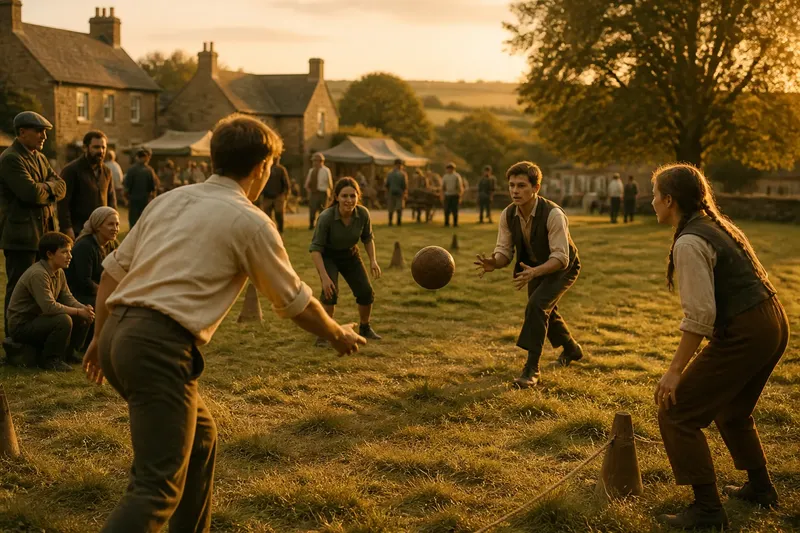
Imagine that residents of a fictional hamlet called Merefield begin meeting on a broad piece of common ground after the weekly market. The ground belongs to no club, and the group has no formal organizer. Some bring a soft ball; others turn up to watch or to walk home together. Over several seasons, they settle on a game that is recognizably theirs. This invented example is not a template for every place. It shows how repetition and local decisions can give informal play a durable shape.
The First Gathering
At the start, Merefield’s gathering is not a match. One person tosses the ball toward two chalk marks, another tries to intercept it, and a third suggests that a successful return should count as a point. People drift in and out. The activity lasts only as long as interest does.
That looseness matters. A game can begin with a handful of familiar actions before anyone names it or claims it as a tradition. Participants may borrow a movement from a schoolyard pastime, adapt a local sport, or invent a rule to settle a question that keeps interrupting play. The ingredients are ordinary; the particular combination belongs to the people who keep using them.
In Merefield, the first useful decision is not the scoring rule. It is choosing a place where the group can gather without obstructing market traffic or passing walkers. The patch is visible, easy to reach, and available at a time when people are already in the village. That practical fit gives the gathering a chance to happen again.
A Shared Patch
Repeated play depends on access, but shared ground does not automatically mean unrestricted ground. Merefield’s participants ask the people responsible for the common to agree on a suitable area and time. They also notice where carts, livestock or ordinary foot traffic need to pass. The result is a modest arrangement rather than a claim of ownership.
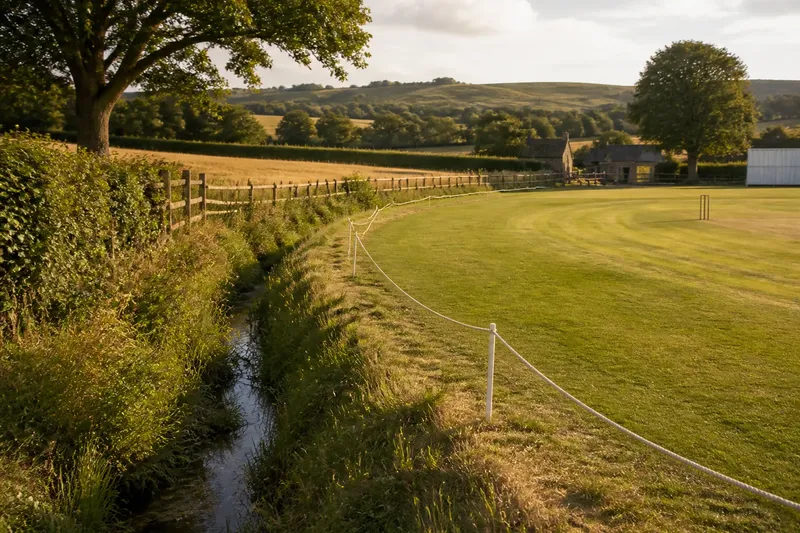
A place influences the kind of game that can develop. A narrow lane might favor throwing or chasing; an open green could allow teams to spread out. A ditch, a gate or a tree may become a reference point in local rules, provided that the feature is safe and does not inconvenience others. The local character comes partly from this fit between activity and surroundings, not from a picturesque setting alone.
At Merefield, the group agrees to use a clear section of common ground after the busiest market traffic has passed. A boundary is marked with removable cones, then moved when walkers need more room. This is a fictional choice, but it illustrates a lasting principle: access is maintained through attention to other users, not by assuming that a familiar gathering has priority.
Rules Through Repetition
Once people return, the same disputes recur. Does a ball that rolls beyond the chalk count as out? Can a player carry it, or only pass it? Does a late arrival enter immediately or wait until the next round? In Merefield, the group answers these questions as they arise, then remembers the answers well enough to apply them next time.
Rules become recognisable when they make play intelligible and disputes manageable. They need not be numerous. A few shared terms can be enough: where play begins, how a point is scored, when a turn ends, and how sides are chosen. Participants may alter these agreements as the group changes, but they need a consistent version for any one gathering or the game becomes a fresh negotiation every few minutes.
Say a new arrival reaches the common while Merefield’s teams are already playing. One regular explains that the newcomer can join the next round, and the group pauses long enough to show the boundary and the scoring action. The expected observable result is simple: the newcomer knows where to stand and what to do, while the current play continues without a long interruption. That small act of explanation can matter more than a polished name for the game.
What Makes a Gathering Last?
For a local game to endure, it needs more than a clever rule. It needs a reason for people to return, room for different levels of skill, and enough flexibility to survive changes in weather, work and attendance. Merefield’s group learns that a game designed only for its most confident players leaves the rest with little reason to come back.
The group responds by keeping the play informal and rotating who starts. A younger participant can take a shorter throwing distance; a person who would rather watch can help call boundaries or keep the ball from rolling into the road. These are not universal rules. They are local choices that make this particular gathering easier to share.
A recognizable game also needs some continuity. Merefield’s players agree on a recurring meeting time, but do not treat absence as failure. If the common is unavailable, they skip that week rather than force play into an unsuitable space. The group’s identity comes from a pattern people can remember, not from keeping a record at any cost.
When Does Play Become a Local Game?
Does a local game need a formal name?
No. A name can help people invite others or distinguish the pastime from a casual kickabout, but shared rules and a repeated gathering are more telling. In Merefield, people begin calling it “market ball” only after the routine is familiar.
How many rules does an informal game need?
Enough to settle the recurring questions that interrupt play. A group can start with a boundary, a way to score and a way to restart, then add or revise rules when a new problem actually appears.
Can a game belong to a place without being old?
Yes. Local attachment grows through repeated use, shared language and people showing newcomers how to take part. A recent pastime can become part of community life without pretending to have an ancient origin.
What happens when the original players move on?
The game can continue if its rules are explainable and new participants are welcomed into the routine. If the gathering depends on one person remembering every detail, it may change or fade when that person leaves, which is a normal possibility rather than a defect.
From Play to Fixture
In the imagined Merefield, the game becomes more organized only after people outside the regular group ask to join. The players settle on a name, write down the few rules that tend to be forgotten, and arrange an occasional meeting with a neighboring hamlet. A fixture list now makes sense because there are willing participants and a shared understanding of what they are playing.
Formal structure can help coordinate people, but it is not the source of local character. That character lies in the route by which a pastime took shape: the available patch, the market-day rhythm, the choices made about access and the way each generation learned the rules. Another village might have a different starting point and reach a different game.
So, if you are trying to understand how local games took root, look for the repeated gathering before the organized competition. Ask who could join, what people adapted, and how the group shared its space. The fixture list may tell you when matches happen; the ordinary decisions made before it existed tell you why the game belongs there.